
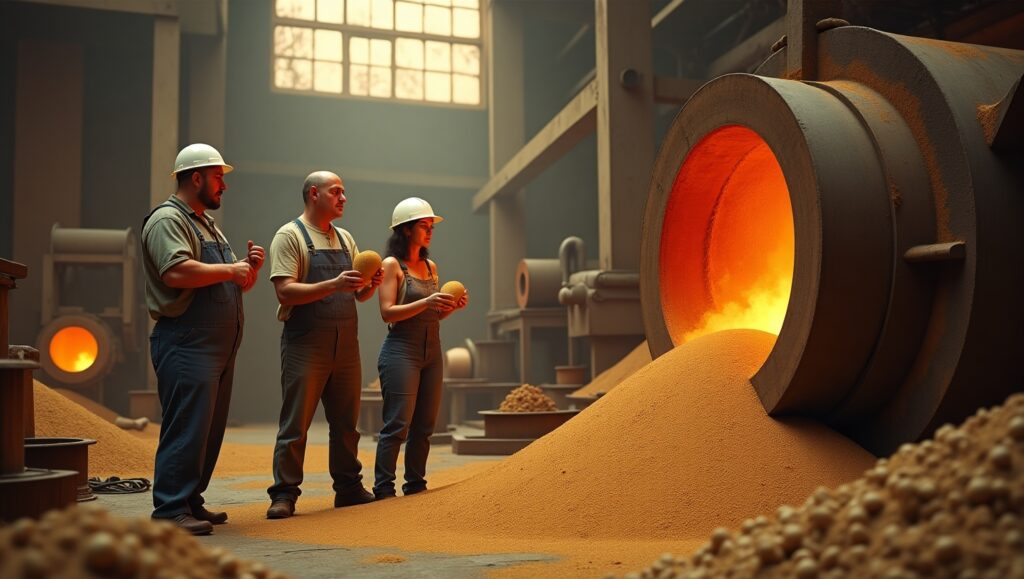
Recycling Foundry Sand: A Sustainable Approach to Metal Casting
Introduction
In the modern age of sustainability, every industry is seeking ways to minimize environmental impact while maintaining efficiency and economic viability. The metal casting industry is no exception, and one of the most effective strategies for achieving these goals is the recycling of foundry sand. Recycling foundry sand plays a crucial role in promoting sustainability in metal casting by providing a method for the reuse of vast amounts of sand that would otherwise become waste. This practice not only helps protect the environment but also provides significant economic benefits, making it a cornerstone of forward-thinking manufacturing strategies.
Table of Contents
ToggleBackground
Foundry sand is a high-quality silica sand that serves as an essential component in the metal casting process. Each year, the industry generates approximately 6-10 million tons of spent foundry sand, posing a substantial environmental challenge if not properly managed (source: General Kinematics). The traditional approach to disposing of this spent sand involves landfilling, which is not only wasteful but also deleterious to the environment. To combat this, the focus is shifting towards innovative foundry sand reuse strategies. These strategies aim to reclaim sand for repeated use in casting or repurpose it into construction materials such as concrete, thereby reducing resource consumption and landfill reliance.
Trend
The trend toward metal casting recycling is rapidly gaining momentum across the globe, primarily driven by the growing emphasis on eco-friendly manufacturing practices. Companies are increasingly adopting these sustainable methods to align with global environmental goals and customer expectations. For instance, several foundries have successfully implemented closed-loop sand reclamation systems that recycle sand to near its original state, significantly reducing the need for virgin sand and cutting operational costs. Real-world examples, such as those highlighted in case studies, demonstrate how sustainability in metal casting is moving from an ideal to a norm. These initiatives highlight the transformation of the industry by showcasing how manufacturers can thrive both environmentally and economically through conscious choices.
Insight
Recycled foundry sand offers economic benefits that extend beyond environmental conservation. By reusing sand, foundries can significantly decrease the costs associated with purchasing and disposing of virgin sand. The reclaimed sand often meets—if not exceeds—the performance standards of virgin sand, making it a viable alternative for use in the casting process. Think of it as akin to reusing paper; although newly produced paper is often required, the recycled versions serve numerous purposes effectively, reducing waste and conserving resources. These insights underscore how metal casting recycling not only preserves the environment but also enhances the industry’s bottom line.
Forecast
Looking forward, the future of foundry sand recycling is promising, with several developments likely to enhance efficiency and boost adoption rates. Technological advancements in sand processing and reclamation techniques are predicted to make recycling processes even more effective and economically feasible. Moreover, there is an expectation that regulations and standards will further encourage or require sustainable practices within the industry. As foundries expand their use of recycled sand, there may also be new applications in sectors such as construction, where its use could grow beyond niche projects into mainstream infrastructure development.
Call to Action
Foundry sand recycling is a proven way to cut landfill, reduce raw-material costs, and slash CO₂ footprints. According to a recent General Kinematics overview, reclaimed sand can be reused many times without compromising casting quality . To turn insight into action, industry teams should pair knowledge-sharing with hands-on collaboration.
At Al Zuhour Al Hamra, we’ve already integrated zero-landfill systems that repurpose foundry sand alongside metal scrap—see the results on our Environment & Sustainability page. We invite engineers, purchasers, and sustainability officers to exchange case studies, pilot joint projects, and set measurable targets with us.
Engage with the GK article, connect with our specialists, and take the next step toward an efficient circular supply chain. Together we can convert these insights into real-world impact—lower costs, stronger compliance, and a greener industrial footprint.
To learn how foundry-sand recycling can transform your operation—or to explore a pilot project—please Contact Al Zuhour Scrap.
