
The Hidden Stories of Ancient Ice Cores: Climate Change and Civilization
Table of Contents
ToggleIntroduction
Ancient ice cores are like time capsules, holding secrets from our planet’s past deep within layers of ice that have formed over millennia. These icy archives provide invaluable records of climate history, allowing scientists to read Earth’s environmental story like a diary written in water. Studying these cores not only enhances our understanding of climate change but also offers profound insights into our environmental history and the rise and fall of civilizations. By examining the bubbles, dust, and chemical composition trapped in ice cores, researchers can reconstruct past climates and better predict future environmental shifts.
Background
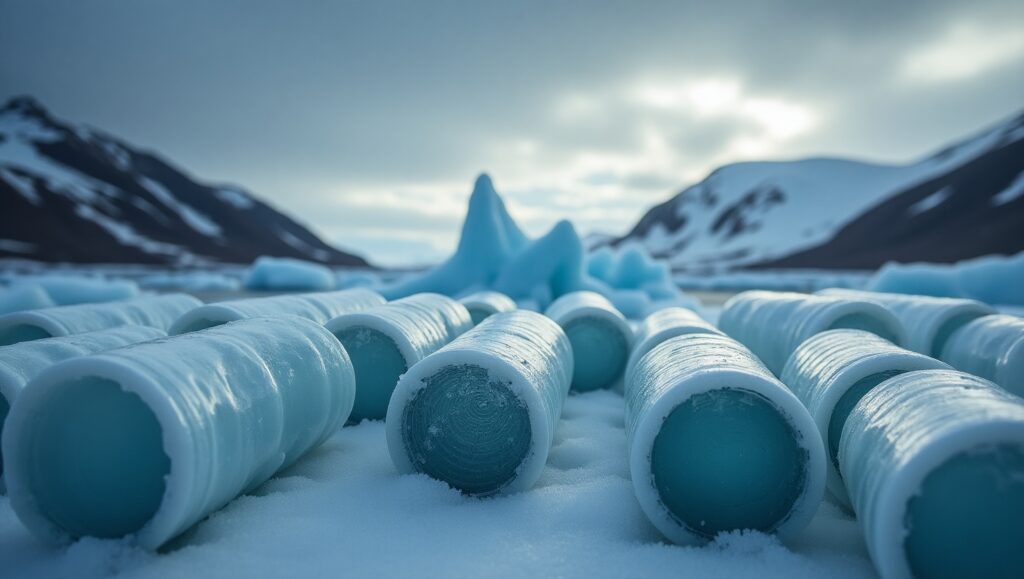
Ice cores are cylindrical samples that scientists drill out of glaciers and ice sheets. Formed from accumulated snowfall that turns into ice over thousands of years, these layers capture atmospheric particles, bubbles of ancient air, and even volcanic ash. Imagine a chapter book, where each layer or year tells a distinct story about the world’s past climate.
The significance of these ice cores extends to Alpine glaciers, which play a crucial role in the climate dynamics of Europe. Recent explorations in the French Alps have produced remarkable revelations. The Mont Blanc glacier, for instance, has yielded a 40-meter ice core dating back over 12,000 years, an era corresponding to the last Ice Age. This discovery offers a window into early human civilization, documenting humanity’s evolution from nomadic groups to settled societies affected by and adapting to climatic shifts (source: ScienceDaily).
Current Trends in Ice Core Research
Advancements in the analysis of ice core samples are accelerating, offering detailed glimpses into atmospheric chemistry over centuries. These trends reveal a stark alteration of the atmosphere due to human activities since the last Ice Age. According to the Desert Research Institute, aerosol studies show significant differences in dust levels and chemical compositions before and after industrial influence. For instance, \”dust was found to be about 8-fold higher during the last Ice Age compared to the Holocene” (source: ScienceDaily).
Researchers like Joe McConnell have remarked upon the comprehensive Alpine records now available, noting, \”For the first time, we have a fairly complete Alpine record of atmospheric and precipitation chemistry going all the way back to the Mesolithic Period\”—a testament to human impact on the planet (source: ScienceDaily).
Insights from Recent Findings
Recent findings from the Mont Blanc ice core underscore the complex relationship between climate change and human development. The chemical signatures extracted from this core reveal shifts in temperature and atmospheric makeup, providing empirical evidence of how natural climates and human activities have shaped the current geological epoch. As Michel Legrand from the French National Centre for Scientific Research elaborates, these cores inform climate modeling by offering data crucial for understanding past interactions and predicting future trends.
Aerosol studies, for example, are central to improving climate models, helping scientists forecast how particles might interact with newer atmospheric changes. An analogy can be drawn with forensic science, where tiny clues unlock narratives of past events—so too do these ice cores unlock the story of Earth’s climatic past.
Forecasting the Future of Climate Understanding
The future of climate understanding hinges on continued ice core research. As we delve deeper into these icy records, we anticipate not only refining climate models but also gleaning insights into how humans can adapt to new challenges posed by climate change. The more we uncover, the better our predictions and preparations for future environmental challenges will be.
In the coming years, scientists hope to expand ice core drilling sites to lesser-studied regions, potentially uncovering new chapters of human adaptation throughout history. This work will be crucial as we strive to design robust strategies for coping with environmental changes currently taking shape.
Call to Action
Awareness and continuous investment in climate research are imperative. Learning about ancient ice cores and their pivotal role in understanding climate change provides a valuable perspective on safeguarding our civilization’s future. Share this knowledge to help broaden awareness. Consider delving into related articles, such as the impactful discoveries in the French Alps, to further appreciate the depth of our planet’s environmental history (source: ScienceDaily).
By staying informed and advocating for climate research, we can collectively contribute to a more resilient future, much like the enduring ice cores that silently narrate Earth’s profound and instructive environmental saga.
For more detailed research insights, visit the ScienceDaily article.
