

In the high-stakes landscape of the UAE energy sector, your decommissioned machinery isn’t just scrap; it’s a strategic reserve of high-value materials waiting for recovery. You likely recognize that managing bulk metal removal while staying ahead of shifting environmental mandates is a complex, high-pressure responsibility. Mastering industrial waste management solutions uae is no longer just about disposal. It’s about securing your operational integrity and protecting your bottom line in a market where efficiency is the standard for success.
This strategic guide provides the technical clarity you need to handle high-capacity industrial recycling and regulatory compliance across the Emirates. We’ll detail how to navigate the National Agenda for Integrated Waste Management 2023-2026 and evolving national regulatory frameworks. You’ll learn to maximize the scrap value of decommissioned assets through specialized recovery processes, ensuring that every tonne of mixed metal or oil and gas equipment is handled with meticulous care. We’ll also address the logistics of seamless national-scale removal to help you avoid the rising costs of non-compliance and escalating landfill gate fees across the Emirates.
Key Takeaways
- Understand the transition from traditional disposal to high-purity material recovery as dictated by the UAE Circular Economy Policy 2031.
- Discover how advanced industrial waste management solutions uae facilitate the recovery of high-grade alloys from decommissioned oilfield equipment and heavy machinery.
- Learn the technical advantages of high-capacity shredding for separating ferrous and non-ferrous materials to maximize the value of mixed scrap streams.
- Identify logistical strategies for coordinating bulk metal removal and demolition scrap management across large-scale national infrastructure projects.
- Establish a rigorous framework for evaluating recycling partners based on their technical capacity and adherence to UAE environmental regulations.
The Landscape of Industrial Waste Management in the UAE (2026)
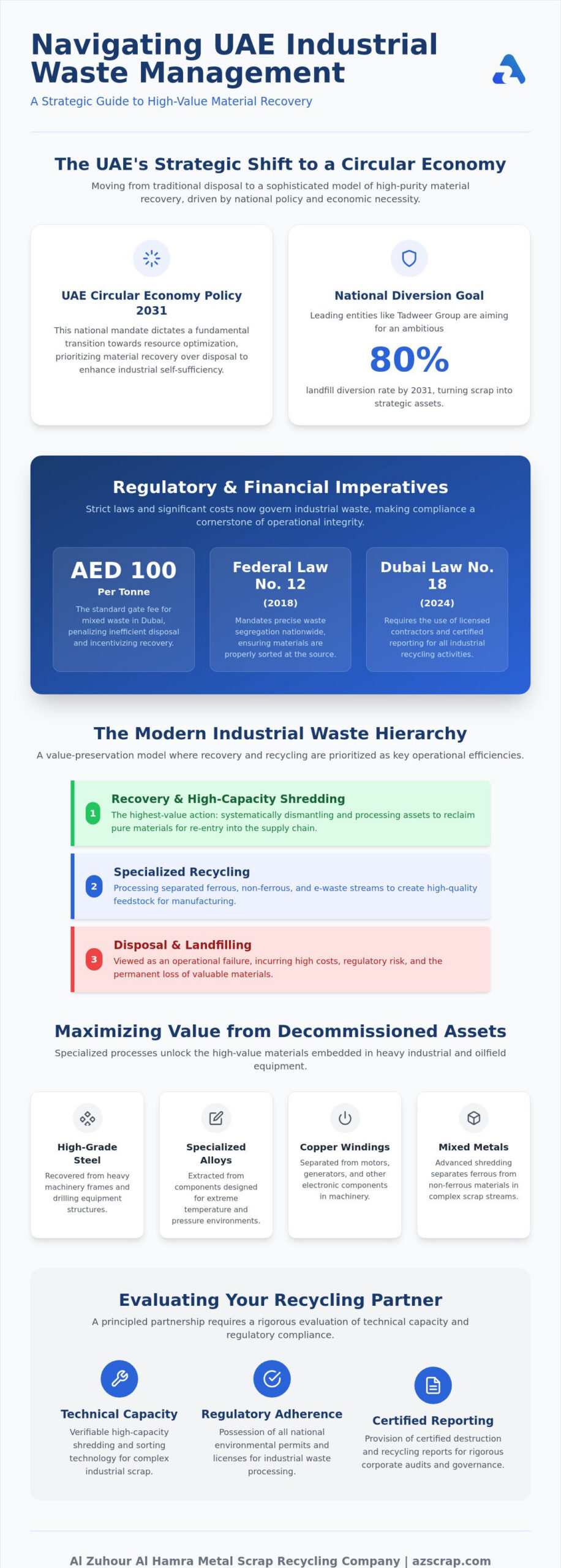
The year 2026 marks a decisive turning point for industrial sustainability in the Emirates. Regulatory frameworks have matured, transitioning from simple disposal guidelines to a rigorous, integrated national strategy. The UAE Circular Economy Policy 2031 now dictates how the energy and manufacturing sectors handle their byproducts. This shift is driven by the necessity to reduce reliance on imported raw materials. Organizations are moving away from traditional landfilling, which now carries significant financial weight, such as the AED 100 per tonne gate fee for mixed waste in Dubai. Instead, the focus has landed squarely on high-purity material recovery.
Implementing effective industrial waste management solutions uae requires more than just basic logistics. It demands a technical understanding of material lifecycles and the ability to process complex, heavy-duty assets. In Abu Dhabi, entities like the Tadweer Group are spearheading infrastructure that supports this transition, aiming for an 80% landfill diversion rate by 2031. This national momentum turns scrap metal and decommissioned machinery into strategic assets rather than liabilities.
Understanding the Industrial Waste Hierarchy
Industrial waste management is the systematic preservation of material value through recovery, ensuring that decommissioned assets become the feedstock for future industrial growth. Recovery and high-capacity shredding sit at the top of this hierarchy. Simple incineration or disposal is increasingly viewed as a failure of operational efficiency. For the manufacturing sector, recycling metal scrap isn’t just an environmental choice; it’s a hedge against volatile global material prices. By 2026, the economic impact of localized metal recovery has become a pillar of the UAE’s industrial self-sufficiency.
Compliance and Environmental Standards
Operating within the UAE requires strict adherence to Federal Law No. 12 of 2018 and Dubai Law No. 18 of 2024. These laws mandate precise waste segregation and the use of licensed contractors for all industrial activities. Firms must secure national environmental permits and maintain certified destruction reports for rigorous corporate audits. This level of transparency is vital for modern governance. Principled waste management protects your organization from long-term liability and the severe penalties associated with mixing hazardous materials with general scrap. It’s a matter of operational security and ethical conviction.
Specialized Decommissioning for Oil, Gas, and Heavy Industry
Decommissioning energy infrastructure in the Emirates is a high-stakes engineering task that demands more than simple demolition. It requires a technical understanding of how to dismantle high-capacity assets while preserving the integrity of the materials. Oilfield equipment is built to withstand extreme environments, which makes its eventual recovery a complex operation. Rigs, pumps, and heavy manufacturing machinery are not merely scrap. They are repositories of high-grade steel and specialized alloys that require systematic extraction to maintain their economic value. Effective industrial waste management solutions uae must treat these assets as strategic resources rather than liabilities.
Lifecycle management for heavy industry begins with the recognition that every component has a secondary purpose. Safe disposal protocols ensure that mixed-material assets don’t end up in landfills, where they incur high gate fees and environmental risks. By following the standards set by UAE federal waste management laws, operators can ensure their decommissioning projects remain compliant and ethically sound. This disciplined approach to material recovery protects the corporate reputation of energy firms while supporting the nation’s industrial self-sufficiency goals.
Oilfield Equipment Recovery and Disposal
The systematic dismantling of heavy drilling machinery requires specialized logistical coordination. Heavy steel frames must be separated from copper windings and rare alloy components to maximize recovery rates. High-capacity processing is the only way to manage these massive waste streams efficiently. It’s a process of precision. Every cut and every sort is designed to ensure that the maximum possible volume of metal returns to the industrial supply chain. If your facility requires certified Oil & Gas Equipment Recycling, partnering with an expert who understands these technical nuances is essential for operational security.
Tungsten Carbide and PDC Drill Management
Tungsten carbide is a critical material in the global industrial supply chain, valued for its extreme hardness and thermal resistance. In the UAE’s drilling operations, PDC (Polycrystalline Diamond Compact) drill bits represent a significant investment that shouldn’t be discarded after their primary use. Specialized recovery programs allow these components to be reintegrated into industrial applications. This lifecycle management reduces the need for virgin material extraction. It’s a principled approach to resource preservation. A partner that understands the full lifecycle of these drilling components ensures that no value is lost during the decommissioning process, providing a seamless transition from use to recovery.
High-Capacity Shredding and E-Waste Recovery Mechanisms
High-capacity shredding serves as the technical backbone of modern material recovery. It’s the critical stage where complex industrial assets are transformed into pure, recyclable streams. For organizations managing massive volumes of scrap, the ability to reduce heavy machinery and mixed metals into manageable fractions is essential. This process isn’t merely about destruction; it’s about the precision liberation of valuable resources. Within the framework of industrial waste management solutions uae, high-capacity shredding allows for the systematic processing of materials that would otherwise be destined for landfills.
The efficiency of these operations is central to Dubai’s waste management approach, which prioritizes technological investment to handle the city’s growing industrial output. By utilizing industrial-scale equipment, firms can ensure that every kilogram of metal is accounted for and processed according to international standards. This disciplined approach to material handling provides a level of operational security that manual processes simply cannot match.
The Mechanics of Metal Shredding and Separation
Modern recovery facilities utilize high-torque, low-speed shredders to prepare industrial scrap for smelting. These machines are capable of rendering heavy steel, aluminum housings, and copper wiring into uniform fragments. Once shredded, advanced separation techniques come into play. Magnetic separators pull ferrous metals from the stream, while eddy current separators isolate non-ferrous materials like aluminum and brass. High-capacity shredding provides a decisive advantage over manual sorting by rapidly liberating bonded materials and ensuring a consistent particle size for high-purity downstream processing. This systematic separation is vital for maximizing the market value of recovered scrap.
Industrial E-Waste and Plastic Scrap Solutions
The recovery of electronic waste in an industrial context requires a focus on both material value and data security. Industrial control panels, servers, and decommissioned telecommunications gear contain ‘hidden’ precious metals that require specialized processing to extract. Physical destruction is the only guaranteed method for ensuring that sensitive data stored on electronic components is irretrievable. Beyond electronics, the sustainable processing of industrial plastic scrap and polymers is equally critical. Documented destruction and recovery reports are now a non-negotiable requirement for ESG reporting. For procurement teams navigating these obligations, understanding the full scope of certified e-waste recycling UAE standards is essential to ensuring compliance with Federal Law No. 12 of 2018 and protecting proprietary data. This transparency ensures that your organization meets its ethical convictions while complying with the UAE’s increasingly rigorous environmental mandates.
Scalable Scrap Management for Construction and Manufacturing
Large-scale infrastructure projects in the Emirates generate massive volumes of material that require immediate, disciplined handling. Construction and demolition waste accounts for approximately 76% of the total waste generated in Dubai, according to the 2025 Municipality Environment Report. This immense volume necessitates scalable industrial waste management solutions uae that can keep pace with rapid urban development. Managing these streams is about more than just moving debris; it’s about the systematic recovery of steel, rebar, and mixed metals to ensure they are reintegrated into the circular economy.
Project managers face the constant challenge of maintaining site efficiency while adhering to strict environmental mandates. Efficient on-site scrap handling protocols are essential for reducing operational friction. When waste is managed with technical precision, it ceases to be a logistical bottleneck and becomes a source of recovered value. This transition is fundamental to the UAE’s broader goals of industrial sustainability and resource preservation.
Infrastructure and Demolition Scrap Logistics
Moving hundreds of tons of metal from a project site is a significant logistical feat. Professional management ensures that steel scrap is optimized for value rather than discarded as low-grade waste. Sorting at the source remains the most effective strategy for maintaining material purity. When rebar is separated from concrete on-site, the recovery value increases significantly. This precision prevents the mixing of materials that would otherwise lead to higher processing costs or increased gate fees at disposal sites. For projects requiring high-capacity removal, our Demolition Scrap Management services provide the logistical framework needed to maintain site integrity.
Manufacturing Waste Minimization Strategies
Factories generate a constant stream of by-products, from metal turnings to plastic offcuts. Integrating scrap recovery into daily factory operations reduces operational friction and improves site safety. A clean floor is a safe floor. Systematic removal protocols prevent the accumulation of hazardous scrap, allowing production lines to remain efficient and focused on output. This approach treats manufacturing waste as a continuous resource stream rather than a periodic problem. By streamlining these processes, manufacturers can achieve the following benefits:
- Improved worker safety through the elimination of scrap piles.
- Enhanced operational flow by reducing the footprint of waste storage.
- Documented compliance for corporate audits and ESG reporting.
- Maximization of revenue from high-value manufacturing scrap.
Establishing a Principled Industrial Recycling Partnership
Selecting a partner for industrial waste management solutions uae is a strategic decision that impacts your operational security and your standing with national environmental regulators. This isn’t merely a vendor selection; it’s the establishment of an alliance built on technical expertise and ethical conviction. A partner must demonstrate the capacity to handle peak project volumes while maintaining absolute transparency in material valuation. In a market moving rapidly toward a circular economy, your chosen provider acts as the guardian of your industrial assets, ensuring that every kilogram of recovered material is processed with meticulous care.
National-scale operations require a provider with a logistical footprint that spans the Emirates. This ensures consistency and a unified approach to compliance, whether your assets are located in the industrial hubs of Abu Dhabi or the construction sites of Dubai. By aligning your waste management with 2026 corporate sustainability goals, you transform a logistical necessity into a source of documented environmental impact. Transparency in recovery reporting is the foundation of this relationship, providing the data required for rigorous corporate audits and ESG disclosures.
Criteria for High-Volume Industrial Partners
Processing capacity is the primary metric for evaluating a high-volume partner. You must verify that they possess the high-capacity shredding infrastructure and specialized sorting lines required to handle the massive influx of materials from large-scale decommissioning projects. Beyond hardware, verification of specialized permits for oilfield and e-waste processing is non-negotiable. A principled approach to industrial stewardship means the partner refuses to cut corners. They ensure that every component, from heavy steel to rare alloys, is handled with documented precision and an uncompromising focus on material integrity.
Next Steps: Auditing Your Current Waste Stream
The first step toward a more efficient recovery strategy is conducting a comprehensive industrial scrap audit. This process identifies ‘hidden value’ in streams that are currently being treated as general waste or low-grade scrap. For instance, mixed manufacturing by-products or electronic components often contain high-value materials that standard sorting processes overlook. By analyzing the full lifecycle of your materials, you can optimize your recovery rates and significantly reduce your environmental footprint. If you are ready to transition to a more disciplined and secure approach, consult with Al Zuhour Al Hamra for a national-scale recovery strategy that prioritizes material value and regulatory excellence.
Securing the Future of Industrial Material Recovery
The transition toward a circular economy by 2026 has redefined the value of industrial byproducts across the Emirates. You’ve seen how specialized decommissioning for the energy sector and high-capacity shredding technology are essential for maintaining regulatory compliance and maximizing asset recovery. Implementing these industrial waste management solutions uae protects your firm from rising landfill fees and ensures that high-value alloys return to the supply chain. Reliability in this sector is built on transparency and technical precision.
Al Zuhour Al Hamra Metal Scrap Recycling Company provides the operational clarity and expertise required for this high-stakes transition. With advanced high-capacity shredding infrastructure and specialized oil and gas equipment recovery expertise, we act as a principled guardian for your materials. Our national-scale logistics across the UAE ensure a seamless removal process for even the most complex heavy assets. Secure your industrial lifecycle with Al Zuhour Al Hamra Metal Scrap Recycling Company’s specialized recovery solutions. We’re ready to help you build a more efficient and sustainable industrial footprint.
Frequently Asked Questions
What are the primary regulations for industrial waste management in the UAE?
Industrial operations must comply with Federal Law No. 12 of 2018 on Integrated Waste Management and the UAE Circular Economy Policy 2031. These frameworks mandate strict waste segregation at the source and the use of licensed environmental service providers. In Dubai, Law No. 18 of 2024 further regulates the handling of industrial scrap and requires digital tracking of waste movements to ensure full transparency.
How is oil and gas equipment safely decommissioned and recycled?
Decommissioning involves the systematic dismantling of heavy drilling rigs, pumps, and subsea infrastructure to isolate high-value alloys. Specialized teams separate heavy steel from copper windings and rare metal components to maintain material purity. This disciplined approach ensures that hazardous residues are managed according to national standards while the bulk of the asset is recovered for industrial reuse.
What is the benefit of high-capacity shredding for industrial metal recovery?
High-capacity shredding provides the technical precision needed to liberate bonded materials from complex machinery fragments. This technology is a cornerstone of modern industrial waste management solutions uae, as it ensures uniform particle size for smelting and maximizes the purity of recovered aluminum and copper. By automating the separation of ferrous and non-ferrous metals, industrial-scale shredders deliver efficiency gains that manual sorting cannot replicate.
Can you provide certified e-waste destruction for corporate compliance?
Physical destruction is the standard for ensuring that sensitive data on industrial control panels and servers is permanently irretrievable. Our e-waste recycling process includes the mechanical shredding of electronic components followed by the recovery of precious metals. We issue certified destruction reports that provide the documentation necessary for corporate audits and ESG reporting requirements.
What types of metals can be recovered from demolition scrap projects?
Demolition projects yield significant volumes of structural steel, rebar, copper wiring, and aluminum fixtures. These materials are processed through high-capacity recovery lines to remove contaminants like concrete or insulation. By separating these metals at the project site, we increase the recovery value and reduce the volume of waste sent to landfills, which helps avoid high gate fees.
Does Al Zuhour Al Hamra provide national-scale logistics for bulk scrap removal?
Al Zuhour Al Hamra operates a national-scale logistical network designed to handle bulk scrap removal from any industrial hub in the Emirates. Our fleet and infrastructure are engineered to manage the heavy-duty transport of decommissioned machinery and demolition waste. This UAE-wide reach ensures that industrial waste management solutions uae remain consistent and reliable for partners with multiple operational sites across different Emirates.
How do you handle specialized materials like tungsten carbide PDC drills?
We treat tungsten carbide PDC drills as high-value strategic assets that require specialized recovery protocols. These components are meticulously separated from drill bodies to be reintegrated into the industrial supply chain. This lifecycle management preserves the extreme hardness and thermal resistance of the material, reducing the need for virgin material extraction in manufacturing.
What documentation is provided to prove compliant industrial waste disposal?
Partners receive a comprehensive suite of documentation, including certified destruction reports, material recovery certificates, and waste transfer notes. These logs are designed to meet the requirements of UAE environmental regulators and corporate governance standards. This level of transparency provides the operational security needed to prove that all materials have been handled with ethical conviction and legal precision.
