
Table of Contents
ToggleIntroduction to Hard Drive Shredding Services in UAE
When it comes to protecting sensitive data and ensuring responsible disposal of electronic waste, hard drive shredding services in UAE play a pivotal role. Whether for businesses or individuals, securely destroying hard drives guarantees that confidential information cannot be retrieved or misused. Moreover, responsible recycling helps reduce environmental impact by diverting hazardous materials from landfill and recovering valuable metals.
Al Zuhour Al Hamra buys and recycles hard disk drive scrap materials in the UAE, including aluminium, steel, copper, and rare-earth magnets. This makes them a trusted partner in handling end-of-life data-storage devices with full compliance to UAE’s environmental and data-protection standards. This guide elaborates on the essential facts, regulatory context, and practical steps for safely and securely disposing of hard drives across the country.
The Importance of Secure Hard Drive Destruction and Data Sanitization
In the digital era, hard drives frequently store highly confidential data such as financial records, personal information, medical histories, or government files. Improper disposal risks exposing this data to theft or fraud. Therefore, secure data sanitization in UAE is mandated by organizational policies and federal data-protection laws such as the UAE Personal Data Protection Law, which requires strict controls over electronic data processing and destruction UAE Official Platform.
Secure destruction ensures that information becomes irrecoverable. This can be achieved either through logical methods (Data Wiping and Overwriting) or physical destruction (Shredding, Pulverizing). Tools and standards such as NIST SP 800-88 Revision 2 guide best practices for sanitization based on data sensitivity, risk assessments, and media types NIST SP 800-88.
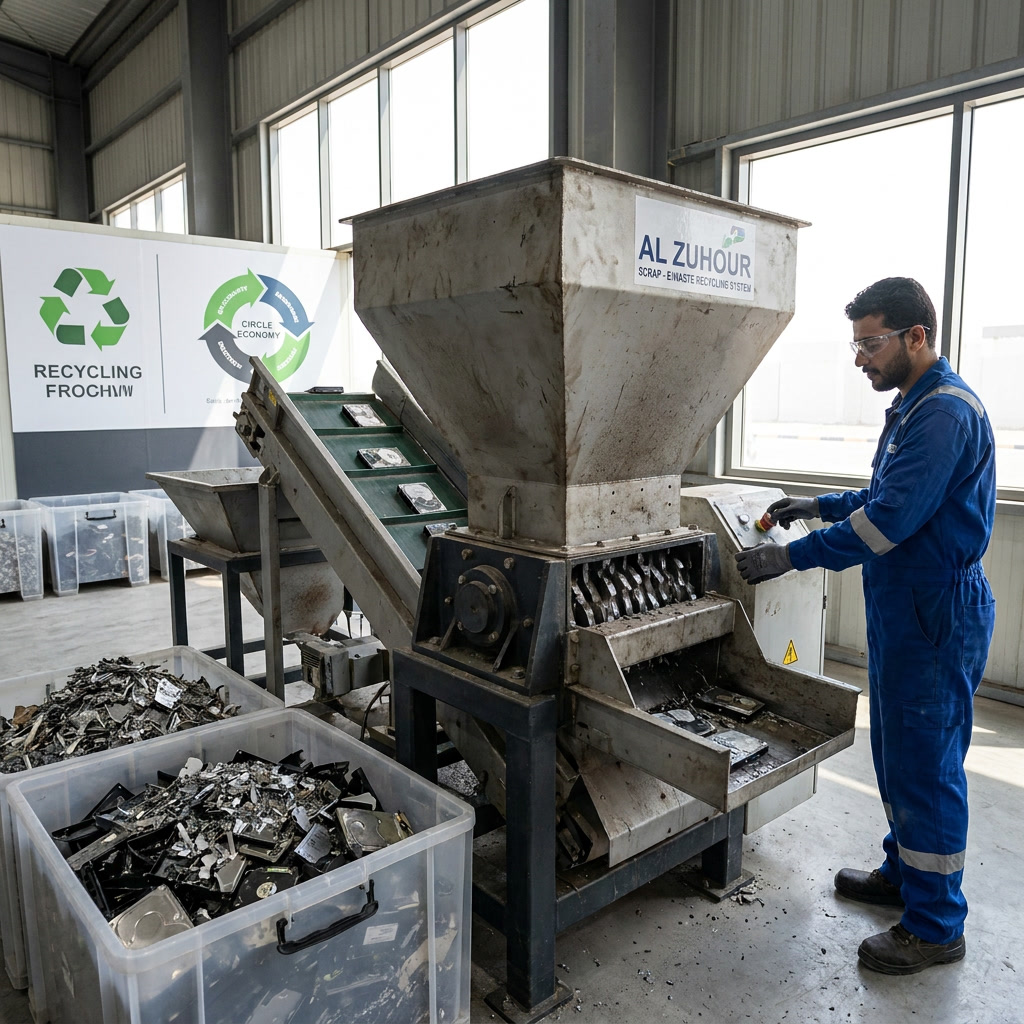
Hard drive shredding physically reduces drives into unusable fragments, making data extraction impossible while simultaneously generating recyclable metal scrap. Choosing the right service for hard drive shredding services in UAE ensures compliance and peace of mind.
Our Approach to Hard Drive Shredding: What Sets Us Apart?
At Al Zuhour Scrap, we view hard drives as complex assemblies containing multiple valuable materials: aluminium top covers, steel chassis, copper wiring, circuit boards, and rare-earth permanent magnets — all recyclable components Journal Study. Beyond mere disposal, careful sorting and processing add environmental and economic value.
Our service emphasizes:
– Asset Identification and Chain of Custody: Each drive is logged with serial number, model, and customer authorization to maintain transparency from collection through destruction, meeting UAE Information Assurance Regulation requirements UAE Information Assurance Regulation.
– Secure Physical Destruction: Utilizing industrial shredding equipment designed for hard drives, ensuring particle sizes meet security standards.
– Data Protection Compliance: Destruction methods aligned with NIST SP 800-88 Rev. 2 guidelines and UAE data privacy laws.
– Environmentally Responsible Recycling: Recovering recyclable metals and components post-shredding, reducing landfill waste Dubai Municipality Guideline No. 7.
These protocols ensure that commercial hard drive shredding is not only secure but also sustainable and compliant with local regulations.
Collection, Transport, and Shredding: Understanding the Process
The process of hard drive shredding involves several coordinated steps tailored to meet UAE regulatory and security requirements:
1. Assessment & Authorization: Customers prepare a detailed asset list that includes serial numbers, data classification, and disposal authorization. This is essential under the UAE Information Assurance Regulation UAE Information Assurance Regulation.
2. Secure Collection: Licensed vehicles and authorized staff collect drives from offices or data centers. The waste transport document accompanies shipments, containing information on type, quantity, origin, destination, and carrier, as required by Federal Cabinet Resolution No. 39 of 2021 Federal Law No.12 of 2018.
3. Transport & Storage: Drives are stored in secured facilities pending destruction. Chain-of-custody records continue to be maintained.
4. Destruction: Drives undergo mechanical shredding that physically destroys the media. Some customers may opt for on-site hard drive destruction for added security, allowing observation of the process.
5. Certification: Upon completion, a destruction certificate is provided. It includes details such as serial numbers destroyed, date, method used, location, and compliance confirmations to support audit and regulatory requirements.
6. Recycling: Shredded fragments are sorted and transferred to downstream licensed recyclers where aluminium, steel, copper, magnets, and circuit boards are recovered and processed Environment Agency–Abu Dhabi Circular.
This controlled and auditable process ensures security while optimizing environmental outcomes.
Secure Data Destruction vs. Physical Shredding: What’s the Difference?
Understanding the distinction between secure data destruction methods is crucial for making informed decisions:
– Secure Data Sanitization: Logical techniques like overwriting or cryptographic erasure that make stored data inaccessible but may allow reuse of the drive. Methods must meet standards such as NIST SP 800-88 Rev. 2 or IEEE 2883-2022 to qualify as effective IEEE 2883-2022.
– Physical Shredding: The mechanical destruction of the storage media into fragments so small that data recovery is impossible. This method destroys the drive and eliminates any reuse value, but simplifies demonstrating compliance for highly sensitive or regulated data.
Secure wiping may suffice for internal reuse or resale if verified correctly, but drives storing sensitive or regulated data often require physical destruction with documented evidentiary proof, typically a valid destruction certificate NIST SP 800-88 Rev. 2.
Choosing between these methods depends on data sensitivity, legal obligations, organizational policies, and risk tolerance.
Regulations and Compliance in Hard Drive Shredding
The UAE’s regulatory environment mandates strict controls around data disposal and e-waste recycling:
– Federal Law No. 12 of 2018 on Integrated Waste Management governs all phases of scrap collection, segregation, transport, recycling, and disposal, requiring licensed handlers and documentation Federal Law No.12 of 2018.
– Federal Cabinet Resolution No. 39 of 2021 defines electronic waste (e-waste), stipulates transport documentation, vehicle authorization, and manifests for inter-emirate movement Federal Cabinet Resolution No. 39 of 2021.
– Dubai Municipality Technical Guideline No. 7 (2026) provides specifics on WEEE recycling processes applicable to discarded hard drives Dubai Municipality Guideline No. 7.
– Environment Agency–Abu Dhabi Circulars and Policies require use of licensed service providers and adherence to manifest systems for WEEE EAAD Circular.
– UAE Personal Data Protection Law demands adequate safeguards including secure disposal methods tailored to data classification, along with documentation and audits when applicable UAE Data Law.
Compliance with these laws protects organizations from liability while safeguarding stakeholders’ privacy and the environment.
Al Zuhour Scrap’s Commitment to Environmentally Friendly E-Waste Recycling
At Al Zuhour Scrap, environmental stewardship is a core commitment. Beyond providing hard drive shredding services in UAE, the company ensures:
– Drives are dismantled and shredded in a manner maximizing recovery of reusable aluminium, steel, copper, circuit boards, and rare-earth magnets Peer-reviewed study.
– Segregation of scrap materials facilitates recycling and reduces landfill disposal impacts in compliance with Federal and Emirate regulations.
– Collaboration with licensed downstream recyclers guarantees that materials from shredded drives are processed according to environmental and safety standards Dubai and Abu Dhabi regulations.
This integrated approach adds value to the scrap stream while aligning with the UAE’s sustainable waste management framework Federal Law No. 12 of 2018.
How to Avail Our Hard Drive Shredding Service in the UAE
Engaging Al Zuhour Scrap’s hard drive shredding service is streamlined to accommodate your operational and data security needs:
1. Prepare Your Material: Identify all hard drives and classify data sensitivity. Compile an asset list including serial numbers, make, model, and destruction authorizations. Separate drives for recycling if reuse is permitted.
2. Contact Us for a Quotation: Provide details such as quantity, location, type (HDD/SSD), condition, preferred destruction method (on-site/off-site), and documentation requirements.
3. Schedule Collection: We arrange secure pickup from Dubai, Abu Dhabi, or other emirates. Licensed vehicles ensure safe, compliant transport with full chain-of-custody documentation.
4. Supervise or Receive Evidence: Choose on-site destruction for physical observation or off-site processing with fully auditable reports and certificates detailing serial-numbered asset destruction.
5. Recycle and Close the Loop: Post-shredding recycling of valuable metals and components is performed responsibly, reducing your environmental footprint.
For tailored advice, visit our E-waste Recycling Services or learn more about our shredding services in UAE.
Conclusion
Hard drive shredding services in UAE are essential for protecting sensitive data, complying with evolving regulations, and responsibly managing electronic waste. Al Zuhour Al Hamra combines secure data destruction expertise with environmentally sound recycling practices, offering businesses and individuals trustworthy solutions fully aligned with UAE legal requirements.
For secure, compliant, and sustainable hard drive disposal, contact Al Zuhour Scrap and benefit from transparent processes, certified destruction, and eco-conscious recycling.
Contact Al Zuhour Al Hamra
—
Sources cited in this article include: NIST SP 800-88 Rev. 2, UAE Information Assurance Regulation, Federal Law No.12 of 2018, and other official UAE government and standards bodies.
