

Could a single oversight in your waste stream really trigger a fine of AED 500,000? Under recent legislative updates across the Emirates, this is the stark reality for industrial operators who fail to manage their disposal workflows with absolute precision. You likely recognize that the logistical complexity of heavy machinery disposal and the inherent loss of value in mixed metal scrap are more than just operational headaches. They represent significant financial risks and missed revenue opportunities for your organization.
Utilizing professional industrial material recovery services allows you to transform these liabilities into high-value assets. This guide provides a strategic roadmap for 2026, ensuring your operations achieve total regulatory compliance through mandatory systems like the Montaji digital platform while securing maximum ROI from recovered materials such as tungsten carbide. We will detail the technical standards required for efficient site clearance and the systematic preservation of material integrity that defines modern industrial stewardship in the UAE. You’ll learn how to navigate the latest federal waste management laws while maintaining a lean, compliant, and profitable operation.
Key Takeaways
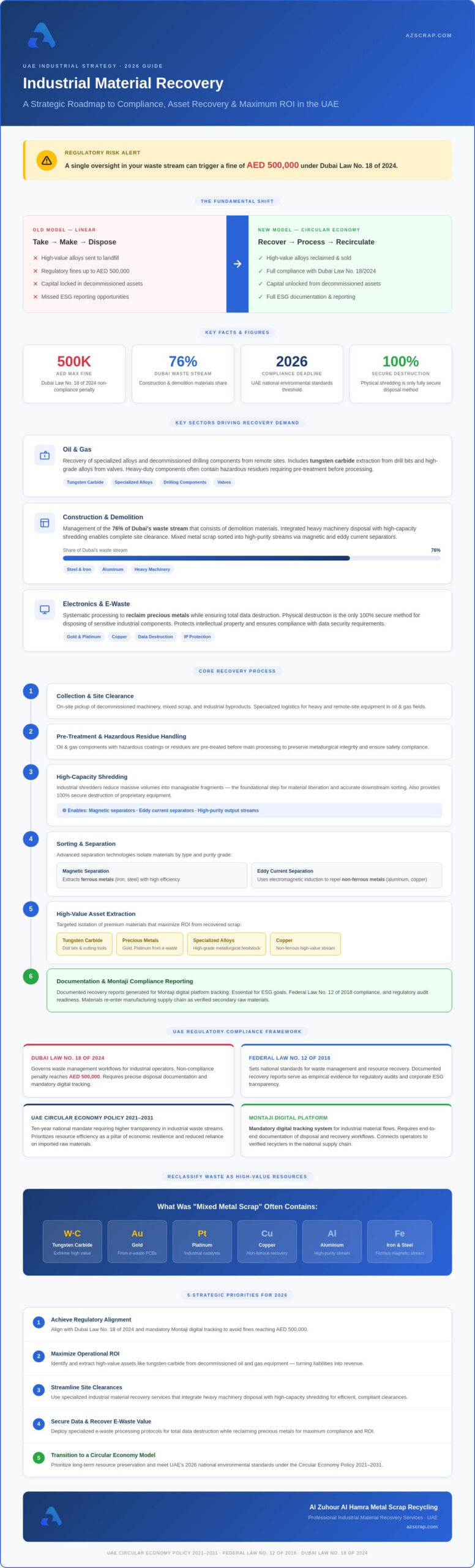
- Mitigate significant regulatory risk by aligning with Dubai Law No. 18 of 2024 and mandatory Montaji digital tracking to avoid fines reaching AED 500,000.
- Maximize operational ROI by identifying and extracting high-value assets like tungsten carbide from decommissioned oil and gas equipment.
- Streamline complex site clearances through specialized industrial material recovery services that integrate heavy machinery disposal with high-capacity shredding.
- Secure corporate data and recover precious metals using specialized e-waste processing protocols designed for rigorous industrial compliance.
- Transition to a circular economy model that prioritizes long-term resource preservation and meets the UAE’s 2026 national environmental standards.
Defining Industrial Material Recovery Services in the Circular Economy
The UAE’s industrial landscape is rapidly evolving away from the traditional, linear “take-make-dispose” model. 2026 represents a critical threshold for corporate compliance, as national zero-waste mandates and the UAE Circular Economy Policy 2021-2031 demand higher transparency. Professional industrial material recovery services provide the technical framework required to transition from waste generation to asset preservation. This discipline involves the systematic extraction of value from manufacturing and demolition byproducts that were previously destined for landfills. By prioritizing the lifecycle of materials, organizations can mitigate the risk of high fines under Dubai Law No. 18 of 2024 while reclaiming significant capital.
Key sectors currently driving the demand for specialized recovery include:
- Oil and Gas: Recovery of specialized alloys and decommissioned drilling components from remote sites.
- Construction: Management of the 76% of Dubai’s waste stream that consists of demolition materials.
- Electronics: Systematic processing of e-waste to reclaim precious metals while ensuring total data destruction.
The Role of Material Recovery in UAE Industrial Strategy
National initiatives for sustainable manufacturing prioritize resource efficiency as a pillar of economic resilience. Integrating Resource recovery into the local supply chain reduces reliance on imported raw materials. This shift has a direct economic impact as recovered metals circulate back into production cycles. Documented recovery reports are now essential for corporate ESG goals and demonstrating adherence to Federal Law No. 12 of 2018. These records provide the empirical evidence required for regulatory audits and stakeholder transparency.
Waste vs. Resource: A Mindset Shift for Operations
Operational success requires a fundamental reclassification of industrial byproducts. What was once dismissed as mixed metal scrap often contains high-value alloys and rare components. Industrial material recovery is a multi-stage process involving collection, sorting, and high-tech processing. Identifying this hidden value reduces the total cost of ownership for heavy machinery and manufacturing infrastructure. Professional recovery rehabilitates the balance sheet by reclaiming capital locked within decommissioned assets. This ensures every kilogram of recovered material contributes to environmental stewardship and operational profitability.
Core Recovery Mechanisms: Shredding, E-Waste, and Equipment Processing
Material recovery is a precise engineering challenge rather than a simple disposal task. Systematic industrial material recovery services utilize high-capacity shredding as the foundational step for material liberation. This mechanical process reduces massive volumes into manageable fragments, which is essential for accurate sorting. It enables the deployment of advanced separation technologies like magnetic and eddy current separators. Magnetic systems extract ferrous materials such as iron with high efficiency. Meanwhile, eddy current separators use electromagnetic induction to repel non-ferrous metals like aluminum and copper from the waste stream, ensuring high purity levels for the recovered assets.
Processing oil and gas equipment demands even greater technical rigor. Heavy-duty drilling components and valves often contain hazardous residues or specialized coatings that require pre-treatment. By isolating high-grade alloys at the source, operators preserve the metallurgical integrity of the secondary raw materials. This methodical approach ensures that even the most complex energy sector assets are returned to the manufacturing cycle without compromising safety. It’s a disciplined workflow that transforms contaminated equipment into clean, high-value feedstock for the local industry. For a deeper understanding of the sophisticated engineering behind these processes, the technical breakdown of large scale metal recycling at high-capacity recovery facilities provides essential context for industrial operators managing complex decommissioning projects.
High-Capacity Shredding for Compliance and Security
Security is a paramount concern for industrial partners in the UAE. Physical destruction remains the only 100% secure method for disposing of sensitive industrial components or proprietary manufacturing equipment. When machinery reaches the end of its functional lifecycle, documented destruction prevents unauthorized reuse and protects intellectual property. Organizations looking to secure their proprietary designs while clearing site space should utilize specialized Industrial Shredding Services. This ensures every component is rendered unrecognizable and recycled according to rigorous corporate compliance standards.
Certified E-Waste and Plastic Scrap Management
The complexity of recovering value from multi-material electronic assets requires specialized expertise. E-waste contains a volatile mix of precious metals and hazardous components that demand certified handling to prevent environmental contamination. This focus on resource preservation aligns with the UAE Circular Economy Policy 2021-2031, which mandates a shift toward sustainable manufacturing and cleaner production. Similarly, industrial plastic scrap management transforms polymer waste into reusable raw materials. Adopting these advanced industrial material recovery services helps your business stay ahead of the 2026 plastic ban while maximizing the lifecycle of every asset. If you’re managing a major site decommissioning, you can partner with experts to ensure every material is documented and recovered for its maximum market value.
Maximizing Asset Value: From Mixed Metals to Tungsten Carbide
Asset valuation is the cornerstone of effective resource management. High-performance industrial material recovery services move beyond simple disposal by conducting technical audits of all material streams. Identifying the financial potential in industrial scrap requires a rigorous evaluation of three factors: purity, volume, and material type. In the UAE’s 2026 industrial market, the distinction between general mixed metal scrap and specialized alloys represents a significant shift in project ROI. For example, while mild steel currently trades between AED 0.90 and AED 1.50 per kg, copper scrap commands a significantly higher value of AED 18.00 to AED 26.00 per kg. Failing to separate these materials at the source results in a substantial loss of recoverable capital.
Systematic sorting isn’t just about immediate financial gain; it’s about maintaining the metallurgical integrity of the secondary raw material supply. When industrial byproducts are processed with precision, they transition from “waste” to “certified feedstock.” This process supports the broader manufacturing ecosystem by providing high-quality materials that meet international standards for reuse. It’s a disciplined approach that ensures no value is left on the site floor during decommissioning or manufacturing cycles.
Recovering High-Value Alloys and Specialized Materials
Tungsten carbide and other rare alloys used in heavy manufacturing represent the pinnacle of industrial material recovery. Tungsten carbide PDC drills are strategically vital because they can be re-engineered or processed into high-purity powder for the production of new drill bits. Global demand for recycled industrial metals has reached a peak in 2026, driven by supply chain volatility and a shift toward domestic resource security. By recovering these specialized materials, businesses reduce their reliance on volatile primary markets. This recovery cycle ensures that high-performance components are returned to the energy and manufacturing sectors, supporting a stable supply of specialized industrial tools.
Demolition Scrap and Infrastructure Waste Management
Large-scale demolition projects in the UAE generate massive quantities of steel, copper, and aluminum that require systematic extraction. Effective demolition scrap management involves the strategic removal of infrastructure assets to prevent cross-contamination. Strategic planning for machinery disposal is necessary to minimize operational downtime and ensure the safety of the project site. For many industrial operators, the logistical complexity of heavy machinery removal is the primary barrier to value recovery. Al Zuhour Al Hamra facilitates the distribution of recovered materials to global partners. This international connectivity is bolstered by UAE waste management initiatives that prioritize the diversion of industrial assets from landfills toward high-value recovery plants. This ensures that infrastructure waste is transformed into a strategic economic asset rather than an environmental liability.
Operational Integrity: Safety, Logistics, and Regulatory Compliance
Operational integrity in the UAE industrial sector is defined by a rigorous adherence to systematic precision and legal transparency. Engaging professional industrial material recovery services ensures that every phase of the lifecycle, from collection to final processing, is documented with meticulous care. This “paper trail” is not merely administrative; it’s the primary defense against regulatory liability and environmental risk. In a market where non-compliance can lead to fines ranging from AED 500 to AED 500,000 under Law No. 18 of 2024, the stakes of industrial disposal are exceptionally high. A principled approach to logistics ensures that bulky assets are transported securely across national borders without compromising public safety or environmental standards.
Digitalization has transformed the enforcement of waste management in Dubai. All commercial movements now require a digital Waste Transfer Note (WTN) submitted via the Montaji platform within 24 hours of collection. This level of oversight requires a partner who understands the technical nuances of Federal Law No. 12 of 2018 on Integrated Waste Management. Mixing hazardous materials with general waste, for instance, can result in immediate fines of up to AED 200,000. By maintaining a disciplined chain of custody, industrial operators protect their licenses and uphold their commitment to national sustainability goals.
Navigating UAE Industrial Waste Regulations
Understanding the legal framework is essential for maintaining “Good Standing” with local authorities. Certified recovery processes mitigate the risk of environmental fines and legal liabilities associated with improper disposal. These regulations are designed to support the UAE’s transition to a circular economy, rewarding organizations that prioritize resource preservation over simple landfilling. Every documented recovery action serves as evidence of corporate responsibility during external audits. This systematic documentation ensures that your industrial material recovery services contribute directly to your ESG reporting and long-term operational viability.
Safety Standards in Large-Scale Scrap Handling
Handling high-volume scrap and heavy machinery requires specialized training and heavy-duty equipment. Risk mitigation is particularly critical during the decommissioning of oil and gas installations, where pressurized vessels and specialized alloys demand expert handling. You can learn more about our rigorous standards for Oil and Gas Equipment Disposal to see how we manage these high-stakes environments. Professional recovery teams utilize advanced rigging and transport logistics to ensure that even the most complex assets are removed without incident. If you require a partner who prioritizes safety and regulatory excellence, you can contact our technical compliance team to schedule a site assessment and logistics review.
Partnering for Excellence: The Al Zuhour Al Hamra Approach
Al Zuhour Al Hamra Metal Scrap Recycling Company operates as a principled guardian of the industrial resource lifecycle. We provide a technical bridge between heavy industry and environmental stewardship. Our national footprint ensures that every emirate has access to industrial material recovery services that meet the highest professional standards. We don’t just manage waste; we manage resources with systematic precision. This proactive stance helps our partners achieve operational clarity while meeting the stringent environmental demands of 2026. By treating every decommissioned asset as a potential resource, we protect the integrity of your supply chain and the health of the local environment.
We maintain a unique position in the UAE market through our dual expertise. We are both a high-capacity recovery leader and a primary supplier of specialized industrial components. This includes the supply of high-value tungsten carbide PDC drills and other recovered industrial parts. This integration allows us to understand the lifecycle of your materials from both ends of the supply chain. It’s a closed-loop approach that maximizes value and minimizes environmental impact. When you partner with us, you’re engaging a team that speaks the language of both global logistics and technical engineering.
Tailored Solutions for Heavy Industry and Energy
Manufacturing plants and oilfield operations require more than generic disposal plans. They need custom recovery strategies that account for technical complexity and the handling of specialized alloys. We design these plans to integrate seamlessly into your existing workflows, ensuring minimal disruption to your daily operations. Choosing a single-source partner for both disposal and component supply simplifies your logistics and reduces administrative overhead. Our commitment to long-term impact means we prioritize recovery over landfilling in every scenario. This principled approach protects your brand’s reputation while reinforcing your commitment to national sustainability goals.
Initiating Your Recovery Strategy
Starting a comprehensive recovery program begins with a technical site assessment. Our experts visit your facility to identify value in your material streams that might otherwise be overlooked. We perform a detailed valuation based on current market indices for metals and specialized alloys. Once the valuation is complete, we establish a structured schedule for bulk removals or recurring waste management contracts. This methodical process ensures that your 2026 operational planning is both compliant and profitable. Don’t let valuable materials sit idle on your project sites. You should consult with our industrial recovery experts today to secure your assets and streamline your site clearance.
Securing Your Industrial Future through Principled Resource Stewardship
Adopting a strategic approach to material recovery is no longer optional for UAE industrial leaders. As we move through 2026, the intersection of rigorous environmental ethics and operational efficiency defines market leadership. By utilizing professional industrial material recovery services, your organization moves beyond mere disposal to embrace a circular model that preserves the metallurgical integrity of every asset. This transition ensures your operations remain compliant with federal mandates while capturing the significant value locked within mixed metal scrap and decommissioned machinery. You’ve seen how systematic sorting and high-capacity shredding protect your balance sheet and your legal standing.
Al Zuhour Al Hamra acts as your principled partner in this transition. We offer specialized Oil & Gas recovery expertise and comprehensive national UAE coverage to ensure every kilogram of material is processed with meticulous care. Our expert approach to environmental ethics provides the security and transparency your stakeholders demand. It’s time to transform your byproduct stream into a strategic advantage. Optimize your industrial resource lifecycle with Al Zuhour Al Hamra. We’re ready to help you build a more resilient and responsible industrial footprint for the years ahead.
Frequently Asked Questions
What are industrial material recovery services?
Industrial material recovery services are specialized engineering and logistical workflows designed to extract maximum value from manufacturing and demolition byproducts. Unlike general waste disposal, these services prioritize the preservation of material integrity to return secondary raw materials to the supply chain. This process involves technical audits, high-capacity shredding, and advanced mechanical separation to identify and reclaim high-value assets that would otherwise be lost to landfills.
How is industrial material recovery different from standard recycling?
Industrial recovery differs from standard recycling through its technical rigor and focus on heavy-duty asset preservation. While standard recycling often handles mixed consumer waste, industrial-scale recovery manages complex machinery, specialized alloys, and large-volume manufacturing scrap. This discipline requires advanced separation technologies and a deep understanding of metallurgical standards to ensure the recovered materials meet the strict requirements of industrial manufacturing and energy sectors. Understanding the full industrial recycling lifecycle, including how precision-engineered facilities approach large scale metal recycling for oilfield waste and heavy machinery, illustrates why specialized expertise is essential for maximizing scrap value.
What types of materials can be recovered from oil and gas equipment?
Decommissioned oil and gas equipment contains a wealth of high-value materials including stainless steel, copper, brass, and specialized alloys. We focus on recovering critical components like tungsten carbide PDC drills which are strategically vital for the energy sector. By isolating these materials from hazardous residues and coatings, we ensure that valuable metals are returned to the production cycle while adhering to the UAE’s strict environmental standards.
Is e-waste processing secure for corporate data?
Secure e-waste processing utilizes high-capacity physical shredding to ensure total data destruction. This is the only 100% secure method for disposing of servers, hard drives, and proprietary electronic components. Our protocols meet rigorous corporate compliance standards, providing a verifiable “paper trail” that documents the destruction of sensitive information. This systematic approach protects your intellectual property while recovering precious metals like gold and silver from the circuitry.
How does Al Zuhour Al Hamra ensure regulatory compliance in the UAE?
We maintain compliance by adhering to the latest federal and local mandates including Dubai Law No. 18 of 2024. Our team manages all digital Waste Transfer Notes (WTN) via the Montaji platform within the required 24-hour window. This disciplined oversight prevents the risk of significant fines and ensures that every recovery action is documented for legal and environmental audits, supporting your organization’s ESG goals and industrial license standing.
Can I recover value from mixed demolition scrap?
You can recover substantial value from mixed demolition scrap through systematic sorting and advanced separation technologies. By deploying magnetic and eddy current separators, we isolate ferrous metals like steel from non-ferrous assets such as aluminum and copper. This process transforms what is often considered a logistical liability into a high-value feedstock, maximizing the ROI of your demolition projects and reducing total site clearance costs.
What is the role of tungsten carbide in the industrial recovery cycle?
Tungsten carbide is a strategically vital alloy due to its extreme hardness and high market value. In the industrial recovery cycle, spent PDC drills are processed to reclaim this material, which is then re-engineered or used as high-purity powder for new manufacturing. This closed-loop process reduces the energy sector’s reliance on volatile primary markets and supports the UAE’s shift toward a sustainable, circular economy for specialized industrial components.
How do I start an industrial-scale material recovery plan for my factory?
Initiating a plan for industrial material recovery services begins with a technical site assessment to identify and value your material streams. Our experts conduct a detailed audit of your manufacturing byproducts and decommissioned machinery to determine the potential ROI. We then establish a structured logistics schedule and recurring waste management contracts tailored to your specific operational needs. This systematic approach ensures your factory remains compliant with UAE environmental regulations while maximizing resource efficiency.
