

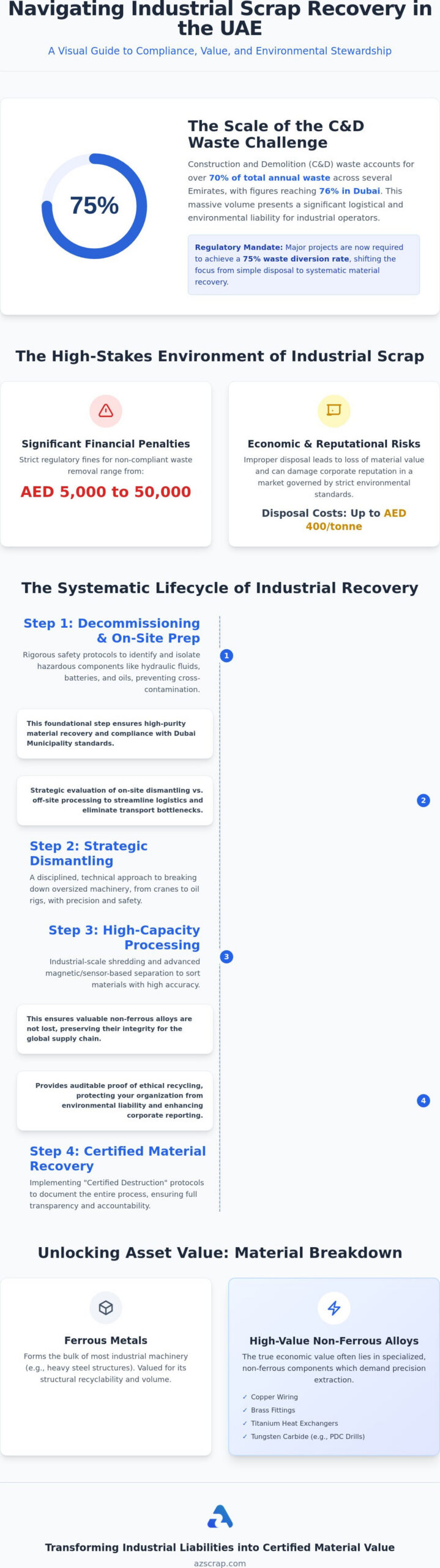
Did you know that construction and demolition waste accounts for over 70% of the total annual waste across several Emirates? For industrial operators in the UAE, the sight of decommissioned excavators or retired oil rigs isn’t just a logistical headache. It’s a massive liability. You’re likely concerned about the strict regulatory fines that range from AED 5,000 to AED 50,000 for non-compliant waste removal. Finding reliable construction site scrap metal solutions is no longer just about clearing space. It’s about protecting your corporate reputation and bottom line in a market governed by the 2026 VAT Reverse Charge Mechanism and temporary export bans.
We understand that managing oversized machinery requires a disciplined, technical approach rather than a quick fix. This guide will help you master the complexities of industrial-scale machinery disposal through systematic recovery, regulatory compliance, and environmental stewardship. We’ll examine the mandatory digital tracking for Waste Transfer Notes and the technical frameworks needed to achieve the 75% waste diversion rates required for major projects. By the end, you’ll have a clear roadmap to transform heavy equipment liabilities into certified material recovery value.
Key Takeaways
- Transition from basic disposal to high-value material recovery by understanding the systematic lifecycle of industrial-scale machinery.
- Evaluate the logistical advantages of on-site dismantling versus off-site processing to streamline your construction site scrap metal solutions and eliminate transport bottlenecks.
- Navigate the 2026 UAE regulatory landscape, including mandatory Waste Transfer Notes and VAT Reverse Charge Mechanisms, to ensure full legal compliance and avoid significant fines.
- Secure certified proof of ethical recycling through “Certified Destruction” protocols to protect your organization from environmental liability and enhance corporate reporting.
- Leverage specialized expertise in oil and gas equipment and heavy machinery to maximize the recovered value of complex industrial assets and drilling components.
Understanding the Scope of Heavy Equipment Scrap Management
Industrial heavy equipment scrap represents a category of waste distinct from routine debris. It consists of high-volume, complex assets such as decommissioned cranes, retired excavators, and massive cooling systems. Unlike general metal recycling, which often focuses on homogeneous streams like aluminum cans or rebar, industrial-scale machinery disposal requires a deep understanding of multi-material assemblies. These machines contain a mix of heavy-gauge ferrous metals, intricate electrical components, and specialized alloys that demand precision during extraction. You aren’t just moving metal; you’re managing a sophisticated inventory of industrial materials.
In the UAE, the movement toward circular economy standards has reached a critical turning point. By 2026, regulations like the National Agenda for Integrated Waste Management have shifted the focus from simple disposal to rigorous recovery. This change is vital because construction and demolition waste accounts for 76% of Dubai’s total annual waste. Implementing advanced construction site scrap metal solutions isn’t just an operational choice. It’s a disciplined response to a regulatory environment that now mandates high diversion rates for large-scale infrastructure projects. Failure to distinguish between general waste and industrial assets leads to significant loss of material value.
The Distinction Between Ferrous and Non-Ferrous Industrial Assets
Successful management begins with a technical assessment of the asset’s composition. Heavy steel structures, or ferrous metals, form the bulk of most industrial machinery and are valued for their structural recyclability. However, the true value often lies in non-ferrous alloys. A foundational step in understanding scrap materials involves identifying high-value components such as copper wiring, brass fittings, and titanium heat exchangers. In the oil and gas sector, this expertise is vital. Specialized components like tungsten carbide PDC drills represent high-density value that general recyclers often overlook. Precise material identification ensures these alloys aren’t lost in a generic shredding process, preserving their integrity for the global supply chain.
Economic Drivers of Industrial Material Recovery
Efficient recovery directly impacts the financial health of your project. With construction waste disposal costs in Dubai reaching up to AED 400 per tonne in 2026, reducing the volume sent to landfills is a fiscal necessity. Systematic construction site scrap metal solutions allow contractors to offset these costs by reclaiming the intrinsic value of the metal. Market fluctuations, such as the July 2026 rise in scrap steel prices, mean that timing and sorting can significantly alter project overhead. Industrial scrap management serves as a disciplined strategy for the preservation of capital value within a project’s lifecycle.
The Systematic Lifecycle of Industrial Machinery Recovery
Industrial machinery doesn’t reach the end of its life when it stops running. It transitions into a high-stakes phase of material recovery. Professional construction site scrap metal solutions treat this transition as a disciplined workflow rather than a simple disposal task. Lifecycle integrity demands that every component is tracked from the moment of decommissioning until it enters a furnace as secondary raw material. This systematic approach ensures that logistical bottlenecks don’t erode the material’s value. It transforms a heavy liability into a strategic asset for the global supply chain.
Decommissioning and On-Site Preparation
Dismantling heavy equipment requires rigorous safety protocols and technical expertise. Before any cutting or transport begins, crews must identify and isolate hazardous components. Industrial machinery often contains hydraulic fluids, heavy-metal batteries, and residual oils that pose significant environmental risks. According to the C&D Recycling Association, proper on-site separation is the foundation of high-purity recovery. In the UAE, failure to manage these hazardous fractions can lead to fines up to AED 50,000 under current 2026 regulations. Identifying these materials early prevents cross-contamination and ensures that the subsequent recycling stages remain efficient and compliant with Dubai Municipality standards.
High-Capacity Industrial Shredding and Separation
Once dismantled and cleared of hazards, the material undergoes mechanical processing. Utilizing industrial shredding services is the only way to achieve the purity levels required by modern steel mills. These high-capacity systems shatter complex assemblies into smaller fragments. Advanced magnetic and eddy-current separators then isolate ferrous metals from non-ferrous alloys, plastics, and electronic scrap. This precision turns a retired excavator or industrial generator into furnace-ready raw materials. It’s a critical step for companies aiming to meet the 75% waste diversion mandate for large-scale projects in Dubai. High-capacity processing reduces the volume of waste destined for landfills by up to 90%, directly supporting the UAE’s Net-Zero goals.
By following this structured recovery chain, industrial operators preserve the intrinsic value of their assets. This methodical flow ensures that every kilogram of steel or copper is accounted for and repurposed. If you’re looking to optimize your asset recovery, consider partnering with a specialist like Al Zuhour Al Hamra Metal Scrap Recycling Company to ensure your decommissioning meets the highest ethical and technical standards.
Strategic Evaluation of On-Site vs. Off-Site Scrap Processing
Deciding between on-site dismantling and direct transport is a critical operational choice for project managers. In the UAE, where large-scale infrastructure projects often occur in remote desert locations or dense urban centers like Dubai, site location dictates the efficiency of construction site scrap metal solutions. On-site processing involves deploying mobile shears and balers to reduce the volume of oversized machinery before it leaves the project boundary. This method significantly lowers transport costs and aligns with the zero-waste-to-landfill targets mandated for projects valued above AED 100 million. It’s a disciplined approach that prioritizes volume reduction at the source.
Conversely, off-site processing is often more suitable for sites with limited spatial capacity. Direct transport to a centralized facility allows for more sophisticated separation techniques that might not be feasible in the field. However, this requires meticulous planning to avoid logistical bottlenecks. Every decision must be underpinned by a commitment to safety. Adhering to OSHA safety and health guidelines ensures that whether processing happens on-site or off-site, the risks associated with heavy metal handling are strictly controlled. This level of oversight is non-negotiable in modern industrial operations.
Logistical Challenges of Oversized Machinery Disposal
Moving a decommissioned drilling rig or a massive manufacturing unit is a feat of engineering. It requires specialized heavy-lift equipment and permits for oversized loads on UAE highways. Managing these logistics isn’t just about physical removal; it’s about optimizing the carbon footprint of the recycling process. By reducing the number of trips required through on-site volume reduction, firms can meet their 2026 ESG reporting requirements while lowering operational overhead. It’s about ensuring the integrity of the logistics chain from the site to the final recovery point.
Maximizing Value for Specialized Materials
Industrial assets often contain components that possess value far beyond their weight in steel. Specialized materials such as tungsten carbide PDC drills require a dedicated recovery stream to maintain their metallurgical integrity. These components are vital for the global supply chain, and their recovery supports a robust secondary market for industrial parts. Precise identification during the dismantling phase ensures these high-value alloys aren’t mixed with lower-grade ferrous scrap. This disciplined approach to material recovery transforms what others see as waste into a strategic reserve of industrial resources. It’s not just disposal. It’s value preservation.
Compliance, Safety, and Environmental Standards in the UAE
Operating within the UAE industrial sector requires a disciplined adherence to a rapidly evolving regulatory framework. As of 2026, the landscape has become significantly more rigorous. Ministerial Decision No. 105 of 2026 recently implemented a temporary four-month ban on the export of specific metal scraps, including iron and copper, to secure domestic supply. Additionally, the new VAT Reverse Charge Mechanism for metal scrap, mandated by Cabinet Decision No. 153 of 2025, requires meticulous financial reporting between registered persons. Implementing professional construction site scrap metal solutions is the only way to ensure your operations remain transparent and legally sound under these high-stakes conditions.
Corporate compliance hinges on the concept of “Certified Destruction.” This process provides documented proof that retired assets were decommissioned and recycled according to national standards, preventing them from entering illegal secondary markets. For companies involved in large-scale infrastructure, this documentation is a vital shield against liability. Dubai Municipality now requires digitally tracked Waste Transfer Notes for every collection. Without these, firms face fines ranging from AED 5,000 to AED 50,000. Documented recovery reports serve as your verified evidence of ethical stewardship, ensuring that your organization meets the 75% to 85% waste diversion targets required for major projects. Understanding the full scope of steel scrap recycling services available in the UAE is essential for navigating these complex export restrictions and VAT frameworks effectively.
Modern heavy equipment is rarely just steel and iron. It often contains sophisticated control systems, sensors, and GPS units that fall under the category of electronic waste. Integrating certified e-waste recycling in the UAE into your machinery disposal plan is essential. This prevents hazardous materials like lead and cadmium from contaminating the ferrous scrap stream. By separating these components, you maintain the purity of your primary metal recovery while fulfilling your legal obligations for hazardous waste management.
Environmental Stewardship and ESG Reporting
Professional scrap management is a cornerstone of modern ESG reporting. By tracking the “Chain of Custody” for every tonne of recovered material, businesses can provide concrete data for their sustainability audits. This transparency supports the UAE’s Net-Zero 2050 strategy by quantifying the reduction in industrial emissions achieved through recycling rather than primary ore processing. It’s a systematic way to demonstrate that your project isn’t just following the law, but actively contributing to national environmental goals.
Safety Protocols for Heavy Metal Handling
Managing the removal of bulk metal scrap presents significant physical risks. Site safety requires mandatory PPE and specialized training for all personnel involved in the shredding and processing phases. Risk mitigation must be proactive. This includes establishing clear exclusion zones during heavy-lift operations and ensuring all cutting equipment is operated by certified technicians. Maintaining a secure environment during the extraction of heavy industrial assets is a non-negotiable standard that protects both your workforce and your operational timeline.
If you require a partner who prioritizes regulatory excellence and operational safety, contact Al Zuhour Al Hamra to secure a compliant disposal framework for your next project.
Optimizing Resource Efficiency with Al Zuhour Al Hamra
Industrial resource management in the UAE has evolved beyond simple disposal. It now requires a partner who operates with the same discipline as your own engineering teams. Al Zuhour Al Hamra (AZSCRAP) stands as a national leader in this transition. We provide a comprehensive framework for construction site scrap metal solutions that prioritizes the preservation of material value over the convenience of a quick pickup. Our operations are governed by a commitment to international standards and a deep understanding of the local regulatory landscape, from Sharjah to Abu Dhabi.
Our capabilities extend across the most demanding industrial sectors. We specialize in oil and gas equipment recycling, machinery disposal, and demolition scrap management. By integrating advanced shredding services with certified e-waste processing, we ensure that no component is wasted and no liability is left unaddressed. This systematic approach allows industrial operators to meet their 2026 sustainability targets while maintaining full compliance with Dubai Municipality and federal waste regulations.
Why National Industrial Leaders Choose AZSCRAP
Expertise in the oil and gas sector is a primary differentiator for our team. We understand the technical complexities of drilling equipment and large-scale manufacturing units. Because we also act as a supplier of tungsten carbide PDC drills, we possess a unique perspective on both the procurement and the recovery of high-value industrial materials. Al Zuhour Al Hamra serves as a meticulous expert in industrial lifecycle management, ensuring that every decommissioned asset is processed with surgical precision to maximize material recovery. This dual role as both a supplier and a recycler creates a closed-loop efficiency that generic scrap traders cannot replicate.
Getting Started: The Industrial Scrap Assessment
The first step toward optimizing your recovery value is a professional industrial scrap assessment. Our team evaluates your on-site scrap volumes and identifies the recovery potential of your specific assets. We don’t offer one-size-fits-all solutions. Instead, we customize a management plan tailored to the logistical needs of your large-scale infrastructure projects. This includes identifying the most efficient construction site scrap metal solutions for your location, whether that involves on-site dismantling or direct transport to our certified facilities.
Establishing a long-term partnership ensures that your waste management remains sustainable and compliant as regulations continue to shift. We provide the certified proof of destruction and documented recovery reports your corporate reporting requires. It’s time to move beyond disposal and start recovering the true value of your industrial assets. Contact Al Zuhour Al Hamra today to schedule a technical assessment and secure a principled partner for your industrial recycling needs.
Future-Proofing Your Industrial Scrap Management Strategy
Transitioning from liability to asset recovery requires a disciplined framework that prioritizes precision over speed. We’ve explored how technical material identification and systematic shredding transform oversized machinery into high-value, furnace-ready resources. In a market governed by the 2026 VAT Reverse Charge Mechanism and strict Dubai Municipality diversion targets, your choice of construction site scrap metal solutions directly impacts your legal standing and project profitability. It’s about maintaining operational clarity while fulfilling your environmental obligations with meticulous care.
Al Zuhour Al Hamra provides the reliability and security required for high-stakes industrial operations. As specialized Oil & Gas equipment recovery experts, we operate a high-capacity shredding and material recovery plant designed to handle the most complex machinery. Our UAE-wide industrial compliance certification ensures that every process, from decommissioning to final recovery, meets the highest ethical and regulatory standards. Consult with our industrial experts for a comprehensive scrap management assessment to align your decommissioning workflows with the UAE’s circular economy goals. We’re here to ensure your transition to a sustainable material lifecycle is both seamless and secure.
Frequently Asked Questions
What qualifies as heavy equipment scrap in the industrial sector?
Heavy equipment scrap includes large-scale industrial assets such as earthmoving machinery, industrial generators, and cooling towers. These items are distinct because they contain high volumes of ferrous steel integrated with non-ferrous alloys. Unlike general debris, these complex assemblies require specialized handling to separate high-value metals from structural components during the recovery process.
How does Al Zuhour Al Hamra ensure compliance with UAE environmental regulations?
We maintain compliance by providing digital Waste Transfer Notes and certified destruction reports mandated by Dubai Municipality. Our processes align with the 2026 National Agenda for Integrated Waste Management. We ensure all financial transactions follow the Cabinet Decision No. 153 of 2025 regarding the VAT Reverse Charge Mechanism for metal scrap in the UAE.
Can oil and gas drilling equipment be fully recycled?
Yes, oil and gas drilling equipment is highly recyclable when handled by specialists. Components such as tungsten carbide PDC drills and heavy-gauge steel piping possess significant intrinsic value. Our material recovery process extracts these specialized alloys, ensuring they return to the global supply chain as high-quality secondary raw materials for future industrial use.
What is the role of industrial shredding in machinery disposal?
Industrial shredding is the primary method for turning complex machinery into furnace-ready raw materials. It shatters multi-material assemblies into uniform fragments, allowing advanced separators to isolate steel, copper, and aluminum with high precision. This high-capacity processing is a core part of effective construction site scrap metal solutions for the modern industrial sector.
How is the value of industrial scrap metal calculated in 2026?
In 2026, the value is calculated using real-time market assessments, such as the processed HMS 1 scrap rate which has recently been reported at AED 1,145 to AED 1,150 per tonne. We also factor in the purity of the material and the complexity of the extraction process. These calculations ensure that industrial partners receive the maximum recovery value for their decommissioned assets.
Do you provide on-site dismantling for oversized manufacturing units?
We offer full on-site dismantling for oversized manufacturing units and infrastructure that can’t be transported whole. Our teams deploy mobile cutting and lifting equipment to reduce assets into manageable sections at the project site. This disciplined approach minimizes logistical bottlenecks and reduces the carbon footprint associated with heavy transport across the Emirates.
Is certified e-waste processing included in machinery disposal?
Certified e-waste processing is an essential component of our machinery disposal workflow. Modern industrial equipment frequently contains sensors, control units, and GPS systems that require specialized hazardous waste separation. By isolating these electronics, we prevent lead and cadmium contamination in the primary ferrous scrap stream while ensuring legal compliance for hazardous materials.
How does professional scrap management impact corporate ESG scores?
Professional scrap management provides the documented recovery data needed for corporate ESG reporting. By achieving the 75% to 85% waste diversion rates required for major Dubai projects, firms can quantify their reduction in industrial emissions. This transparency is a key element of modern construction site scrap metal solutions for globally-minded corporations operating in the UAE.
